
Schedule templates
If most weeks look about the same, you don't have to build each one from scratch. Save a good week as a schedule template, and lay it onto any future week in a couple of clicks. You then only adjust for that week's changes.
Templates belong to a location. The templates you see are the ones saved at the location picked at the top right. You need to be a Manager or Administrator there to use them.
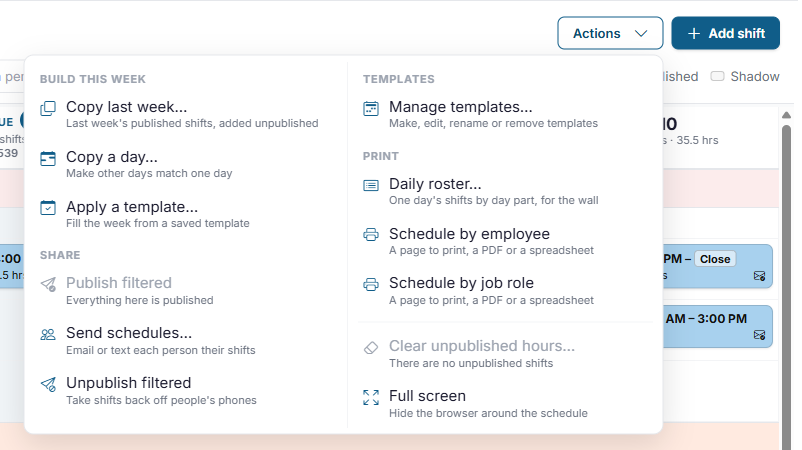
Templates live in the schedule's Actions menu: Manage templates (under Templates) to make, change, rename and remove them, and Apply a template (under Build this week) to use one.
Create a template from a week
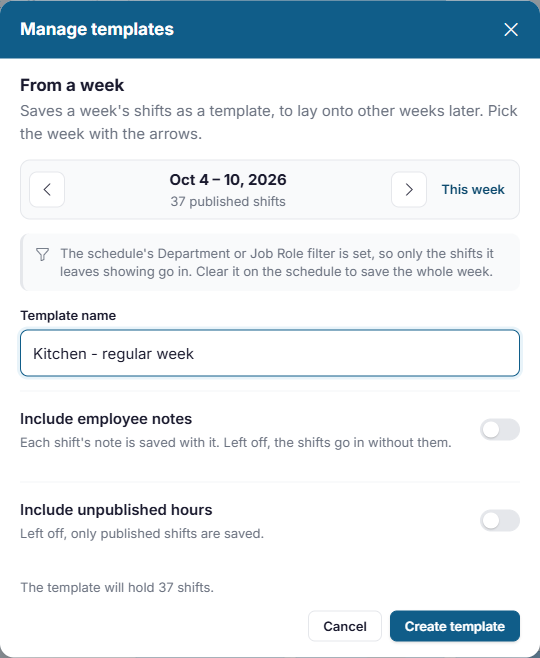
- If you only want part of a week, use the schedule's department and job role filters first. For example, filter to the Kitchen department to save a kitchen-only template. Only the shifts the two filters leave showing go into the template.
- Open Actions, choose Manage templates, and click From a week.
- Use the arrows to go to the week you want to save. It starts on the week you have open, and each week shows how many published and unpublished shifts it has. This week brings you back to the current week.
- Give it a name that says what it's for, such as Regular week or Holiday week.
- Choose whether to include:
- Employee notes: each shift's note is saved with it. Off by default.
- Unpublished hours: off by default, so only published shifts are saved. Turn it on to save a week you're still working on.
- Click Create template. The new template appears in the list, ready to apply or edit.
To build a template from scratch instead, click New template, give it a name, and it opens on the schedule, empty, for you to add its shifts (see Change a template's shifts below).
The template keeps each shift's employee, job role, day of the week, times and End Display. House shifts are saved too, still with nobody on them. Shadow shifts are left out, since they are just copies of shifts in another job role.
Apply a template to a week
- Go to the week you want to fill. It doesn't have to be empty.
- Open Actions and choose Apply a template.
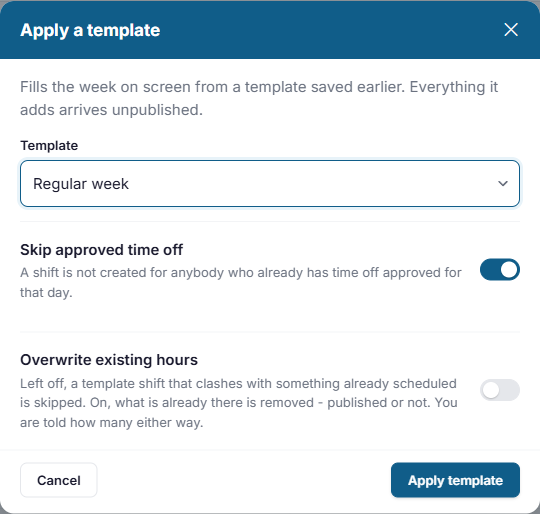
- Pick the Template.
- Check the two options:
- Skip approved time off (on by default): nobody gets a shift on a day they have approved time off. A day runs from the time your location starts a new day, so a late shift that ends after midnight still counts as the day it started.
- Overwrite existing hours (off by default): if a template shift clashes with something already on the schedule, the template shift is skipped. Turn this on to remove what's already there instead, published or not.
- Click Apply template.
A summary shows how many shifts were added to each day. If any were skipped, it lists them and says why: for example, the employee had approved time off, has left, no longer works at this location or in that job role, or was already working at that time.
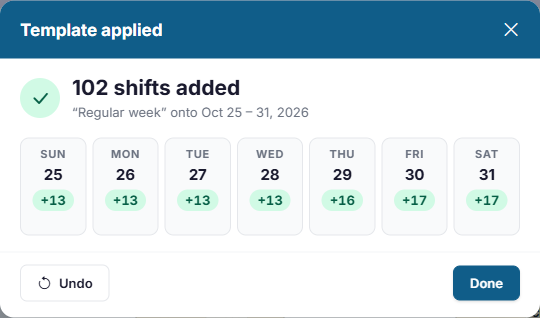
Everything a template adds is unpublished, so check the week, make your changes, then publish it as usual. If you applied the wrong template, click Undo in the summary, or use the schedule's undo arrow.
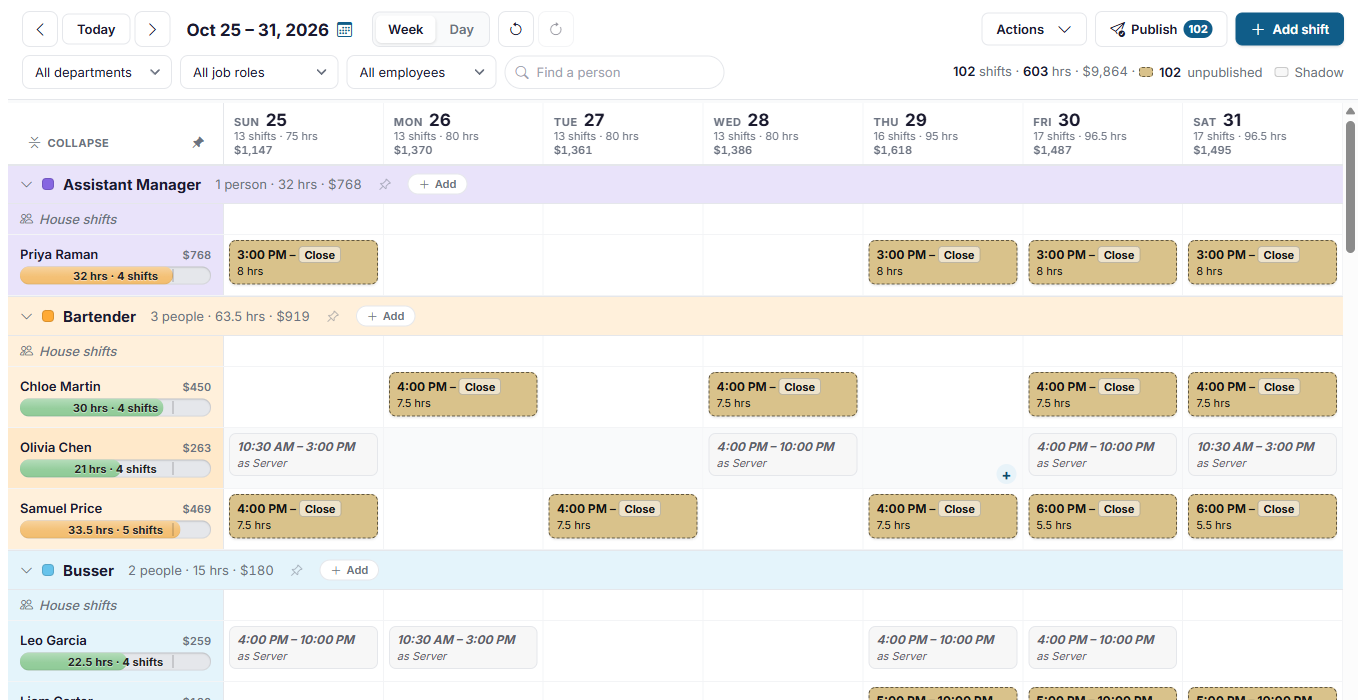
Overwrite existing hours removes published shifts too, and removing a shift doesn't notify anyone. If you overwrite a week your team has already seen, send them their schedules again once it's published.
Change a template's shifts
- Open Actions and choose Manage templates. Every template at the location is listed, with how many shifts it holds and the day it was saved.
- Click Edit beside the template.
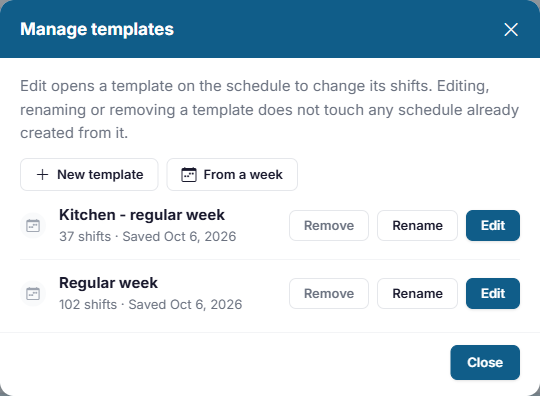
The template opens on the schedule like a week, with Sunday to Saturday and no dates, under a bar saying which template you're editing. Add, change, move, copy and remove its shifts the way you would on any week, and use the undo arrow if you make a mistake. Changes are saved as you make them.
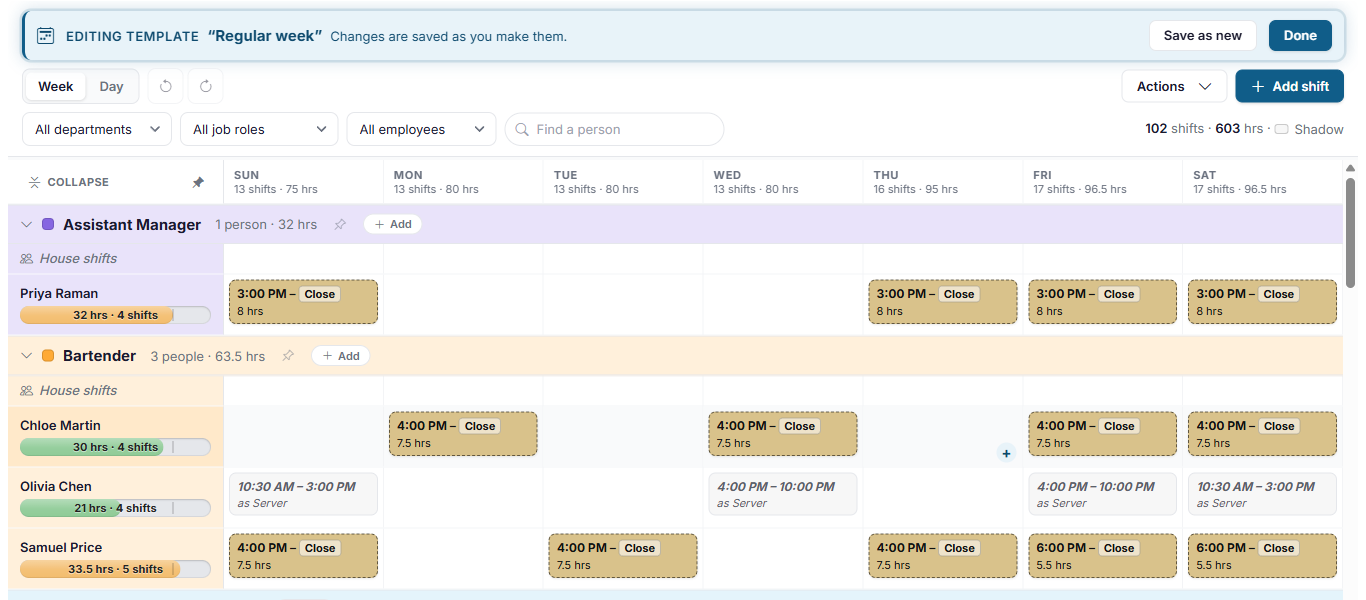
- Done takes you back to Manage templates, over the week you were on, ready for the next template.
- Save as new copies the template under a new name and opens the copy, so you can make a variant, such as a holiday week from your regular week, without changing the original.
Nobody can be on two overlapping shifts within a template. Whether they're free on a real week, including at your other locations, is checked when you apply the template.
Rename or remove a template
Open Actions and choose Manage templates, then use the buttons beside the template:
- Rename: type the new name and press Enter or click Save. Cancel or Esc keeps the old name. Two templates at one location can't share a name.
- Remove: confirm, and the template is gone from the list.
Editing, renaming or removing a template never changes a week you already filled from it.
Templates, or copying last week?
- Copy last week (in Actions) copies last week's published shifts as they are. It's quickest when this week will look like last week, but it doesn't skip approved time off.
- A template is better for a week you come back to again and again, such as a regular week, a holiday week or a week with a big event. It can skip approved time off.
- Copy a day (in Actions) copies one day's shifts onto other days of the same week, for example to make every weekday match Monday.
No Comments